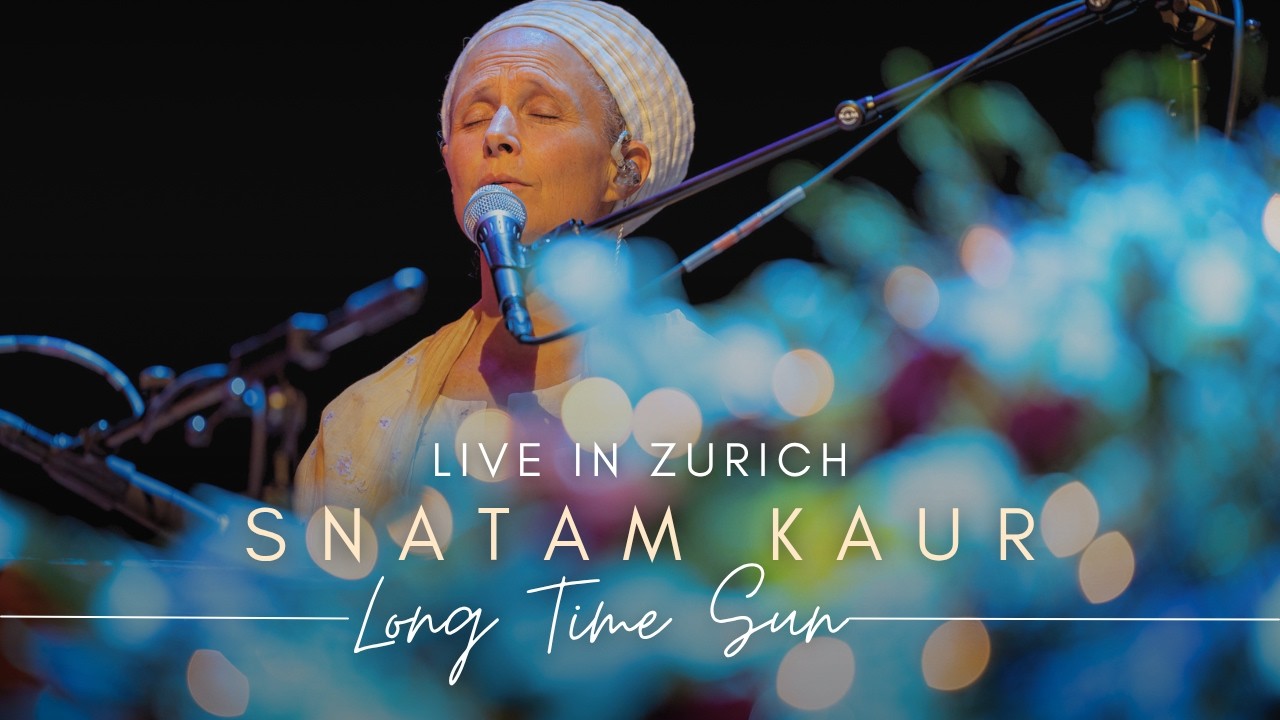
In this brief announcement, Snatam Kaur explains her conviction that chanting and kirtan—sacred Sikh devotional music—have the capacity to cleanse, transform, and liberate the heart. She describes concerts as moments where the band, audience, and performer become unified in the sacredness of the words, creating an experience of spiritual renewal and second chances. She announces a comprehensive fall 2024 tour across the United States, Canada, South America, and Latin America, with particular emphasis on long-awaited returns to Mexico City and Santiago, Chile after an 8-year absence, plus first-time performances in Brazil.
What is the Spiritual Power of Chanting According to Snatam Kaur?
Snatam Kaur grounds her musical practice in a clear philosophical conviction: chanting possesses transformative power. She does not describe this as metaphorical or poetic—she speaks from direct experience. The mechanism she identifies is one of cleansing and clearing, specifically targeting the heart space. This language—"cleanse," "clear," "freedom"—suggests that in her understanding, the heart accumulates obstacles, weights, or obscurations that prevent access to joy. Chanting, as she practices and teaches it, functions as a tool to remove those obstructions.
What distinguishes her approach from secular performance is the framing of concerts as spiritual journeys rather than entertainment events. She has watched her own concerts evolve over years into deeply spiritual experiences. This evolution is significant: it indicates that the spiritual dimension does not emerge automatically from music alone, but rather develops through intentional cultivation, repeated engagement, and a commitment to the sacred dimension of the practice.
How Does Collective Kirtan Create Unified Experience?
Kaur describes a specific phenomenon that occurs when a band, audience, and performer chant together: they become one. This is not merely a poetic description of good vibes or crowd energy. She articulates a merging of distinct entities—the musical container (band), the individual listeners (audience), and the facilitator (herself)—into a single unified consciousness or experience. The vehicle for this unity is "the sacredness of the words."
This suggests that the words themselves carry meaning and resonance that transcends personal interpretation. In Sikh tradition, from which much of her repertoire draws, words (shabads) are understood to carry spiritual vibration and significance. When spoken or sung collectively with intention, these words create a shared field. The experience is not about individual emotional catharsis, but about stepping into something larger than oneself—a field of sacred language that holds and contains everyone present.
What Does "Second Chance" Mean in the Context of Heart Clearing?
One of Kaur's most direct claims is that "there's always a second chance, a clean slate and a clear heart that becomes available and known to us in this type of chanting experience." This statement carries psychological and spiritual weight. It acknowledges that people arrive at chanting experiences carrying histories—trauma, regret, shame, mistakes. The claim is not that these disappear or are erased, but that a reset becomes possible.
The phrase "available and known to us" is precise. The second chance does not come from outside; it becomes accessible from within through the practice. The clear heart—the heart unobstructed by past pain or self-judgment—is revealed as always having been there, beneath the accumulated layers. Chanting, in this model, is archaeology of the spirit: clearing away what obscures the inherent clarity that exists beneath.
This teaching is not confined to any particular religious or cultural background. Kaur emphasizes that "it doesn't matter who we are, or what we've been through"—the mechanism works across identity and history. This universalism is central to her mission and explains the breadth of her audiences across continents.
Why Does Returning to Latin America After 8 Years Matter?
Snatam Kaur expresses personal excitement about returning to Santiago, Chile and Mexico City after an 8-year absence. She states plainly: "That's too long!!" This is not casual scheduling talk; it reflects a relational commitment. She acknowledges having "long time supporters of our music in Latin America" and frames her return as an act of reciprocal giving: "it feels wonderful to give back in some way."
This reveals her understanding of the relationship between performer and audience not as transactional (sell tickets, perform, leave) but as reciprocal and sustained. Listeners who have engaged with her music over years, across miles, merit return and investment. The 8-year gap represents not just time passed, but a breaking of connection that she is now restoring. Her excitement is genuine because it represents fulfillment of a relational debt.
What Makes Brazil a Significant Expansion?
Kaur notes that Brazil represents new territory for her concerts—"we are going to Brazil to perform in concert for the first time with shows in São Paulo and Florianopolis!" This is expansion into a region with significant kirtan and spiritual music communities, yet where her live presence had not previously been established. The fact that she is choosing to begin with two cities (rather than a single show) suggests either strong underlying demand or a strategic commitment to establishing presence in the region rather than a one-off appearance.
Where to Go From Here
For those interested in experiencing Snatam Kaur's chanting practice firsthand, the fall 2024 tour provides multiple entry points across North, Central, and South America. The tour dates are:
- September 25 — Sarasota, Florida
- September 27 — Toronto, Canada
- September 29 — Montreal, Quebec
- October 3 — São Paulo, Brazil
- October 5 — Florianópolis, Brazil
- November 7 — Santa Cruz, California
- November 9–10 — Austin, Texas
- November 12 — Fort Worth, Texas
- November 15–16 — Mexico City, Mexico
- November 19–20 — Santiago, Chile
Tickets are available at snatamkaur.com/events. The geographic diversity of the tour—spanning both first-time performances (Brazil) and long-awaited returns (Chile, Mexico)—reflects her commitment to meeting audiences where they are and sustaining relationships across continents.