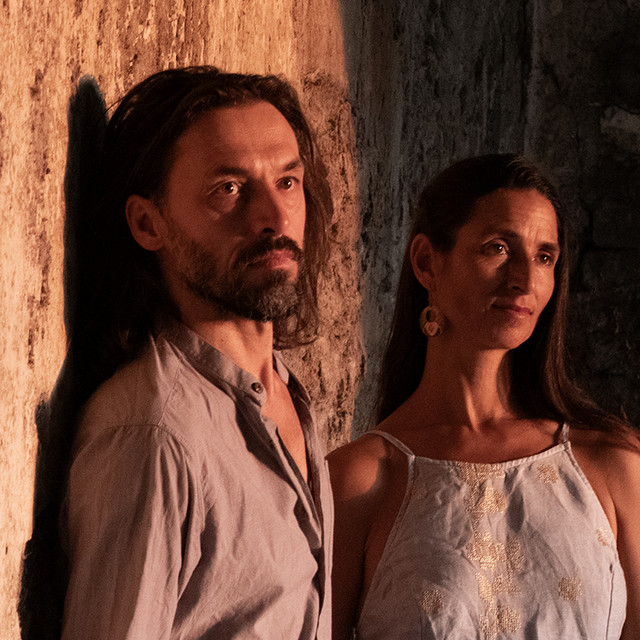
Mirabai Ceiba's live kirtan performance of "Humee Hum" (a foundational Sikh mantra meaning "We are that" or "I am that") demonstrates how sacred sound practice invokes direct experience of non-dual identity in Sikhism. The phrase invokes the recognition that the individual self is not separate from the divine totality—a teaching at the heart of Sikh mysticism. This article explores the mantra's origin, its role in Sikh spiritual practice, and how kirtan artists like Mirabai Ceiba use music and repetition to awaken listeners to that recognition.
What Does Humee Hum Mean in Sikh Teaching?
The mantra "Humee Hum" appears in Sikh sacred texts and carries profound philosophical weight. In Punjabi, "Humee" refers to "we" or "I," and "Hum" means "that"—the ultimate reality or divine essence. Together, the phrase translates variously as "We are that," "I am that," or "We are One." This is not a statement of ego assertion but rather a claim of non-duality: the recognition that the individual consciousness is fundamentally inseparable from the infinite divine consciousness that pervades all existence.
In Sikh metaphysics, this realization represents the goal of spiritual practice. It reflects the teaching that separation between self and God is illusory, and that sustained meditation and devotion strip away that illusion to reveal the truth of unity. The mantra encodes this teaching in its simplest form—a direct affirmation that can be internalized through repetition, especially through the practice of kirtan (devotional singing).
How Does Kirtan Make This Teaching Accessible?
Kirtan is a centuries-old practice in South Asian spiritual traditions, particularly in Sikhism, in which sacred words and mantras are sung, often responsively, in group or solo settings. Rather than treating the mantra as an intellectual concept to be understood through analysis alone, kirtan engages the whole body—voice, breath, rhythm, emotion—in the transmission of spiritual truth.
When Mirabai Ceiba performs "Humee Hum" live, as she did at Union Chapel in London, she is not merely entertaining an audience. She is creating a sonic and spiritual container in which listeners can directly encounter the meaning of the words. The repetition of the phrase, paired with melody and rhythm, establishes a trance-like state of consciousness. The boundaries of listener and singer begin to dissolve. The individual "I" being sung about in the mantra is no longer abstract—it becomes felt, lived, direct.
This is why kirtan artists emphasize that the practice is not a performance but an invitation: an opening for others to participate in awakening to their own non-dual nature. The live setting amplifies this—there is no mediation of recorded sound, but immediate human connection and shared breath in the room.
What Is Mirabai Ceiba's Role as a Kirtan Artist?
Mirabai Ceiba has spent decades as a devoted practitioner and teacher of kirtan, grounded in the Sikh tradition while drawing from broader Hindu and Tantric contexts. Her work carries the authenticity of someone who practices these teachings—she is not a performer playing a spiritual role, but a spiritual practitioner who uses music as her medium of expression and transmission.
In the London concert captured in this video, her role is to hold the space and the sound. This means:
- Leading the mantra with clarity and devotion, allowing her voice to become a vehicle for the teaching rather than a showcase for technical skill
- Creating an opportunity for listeners to synchronize their own breath and heartbeat with the sacred sound
- Inviting participation—kirtan is not typically a performance to be passively consumed, but an active spiritual practice in which the audience joins the singing
- Maintaining the vibrational field of the mantra long enough for it to penetrate ordinary consciousness and awaken recognition
Why Does Sacred Sound Awaken Spiritual Recognition?
There is a reason that virtually all spiritual traditions use sound, music, and mantra in their practice. Sound operates at a level that bypasses intellectual resistance. The rational mind can argue about the truth of "I am that," can dismiss it as metaphor or philosophy. But when the phrase is sung, when it enters the body through the ears and is echoed back through the voice, something shifts. The teaching moves from conceptual to embodied.
In Sikh philosophy, particular mantras are understood to have intrinsic vibrational power—they are not effective because we believe in them, but because their sound structure resonates with the fundamental frequencies of existence. The mantra "Humee Hum" is designed to attune consciousness to the recognition of unity. Repeated singing aligns the nervous system, the breath, and the subtle energy body with that frequency.
Additionally, the live group setting of kirtan creates a coherent field. As multiple voices join in the same mantra, the individual experience of singing alone expands into collective witnessing. The boundaries between self and other soften. This is precisely the state of consciousness that "Humee Hum" points toward—a dissolution of separate identity into a recognition of shared, universal being.
What Makes This London Performance Significant?
The location—Union Chapel in London—is itself noteworthy. Union Chapel is a historic, unconventional sacred space in North London, known for hosting contemplative and interfaith programming alongside music performances. It is not a traditional Sikh gurdwara, yet Mirabai Ceiba's presence there and the filming of the concert indicates a broader cultural moment in which Sikh kirtan practice is being recognized and welcomed in secular Western spaces.
This reflects a larger phenomenon: the growing recognition in the West that practices from non-Christian traditions offer genuine spiritual depth and transformative potential. Mirabai Ceiba has been instrumental in making kirtan accessible to Western audiences—not by diluting or secularizing it, but by presenting it authentically, allowing its inherent power to speak across cultural boundaries.
The brevity of the video (under three minutes) is actually a strength—it offers a concentrated dose of the kirtan experience, a taste of the mantra and the presence Mirabai Ceiba brings. For those unfamiliar with kirtan, it serves as an introduction. For those already practitioners, it is a reminder of the teaching and an invitation to reconnect with personal practice.
How Can Listeners Engage With This Practice?
The mantra "Humee Hum" can be engaged with at multiple levels. Intellectually, one can study the philosophical context of Sikh non-duality and understand what the teaching claims. But Sikh practice suggests that true understanding comes through doing. This means:
- Listening to recordings of "Humee Hum" kirtan repeatedly, allowing the sound to work at a subtle level
- Learning the melody and singing it oneself—even five or ten minutes daily of singing the mantra can shift consciousness over time
- Attending live kirtan events, experiencing the group field and the living transmission that only occurs in real-time community
- Studying the Sikh texts, particularly the Guru Granth Sahib, to deepen intellectual understanding alongside practice
- Approaching the mantra not as an achievement to master but as an endless invitation—each repetition reveals new layers
Where to Go From Here
This video is a gateway into a larger world of Sikh kirtan and Western engagement with this tradition. Those interested in exploring further might investigate Mirabai Ceiba's wider discography and teachings, as well as the classical Sikh hymns and practices that underlie her work. The mantra "Humee Hum" itself is accessible—it can be sung by anyone, requires no special knowledge, and offers direct entry into the Sikh spiritual path.
For those drawn to the video, the invitation is to move from observation to participation: to find or create a space to sing the mantra, to allow the sacred sound to work on your own consciousness, and to discover whether the claim that "we are that" resonates as true within your own direct experience. This is the essence of kirtan practice—not belief, but living encounter with the teaching that the separate self is an illusion, and that beneath all individuality lies a unity that is the nature of all existence.


